
From Governance to Mechanics: Choosing the Right Access Pattern #
In my previous article on the Agentic Enterprise Blueprint, I explored how Okta positions AI agents as first-class identities within the enterprise security fabric. We examined the strategic framework answering three foundational questions: Where are my agents? What can they connect to? What can they do?
But strategy without execution is just theory. Now we must answer a more practical question: How should AI agents authenticate and authorize their communications with enterprise resources?
This guide is designed to help architects, security teams, and solution engineers evaluate the four access patterns Okta for AI Agents provides for AI agent integrations. By the end, you’ll understand:
- Which pattern fits your security requirements (user context, scope narrowing, audit trails)
- Which pattern your resources support (ID-JAG, OAuth, API keys, or username/password)
- How to compare security levels between patterns
- When to migrate from legacy patterns to modern approaches
This question isn’t academic. The access pattern you choose determines:
- Whether your audit logs capture user attribution: Can you trace an action back to both the agent and the user it acted for?
- Whether you can revoke access surgically: Can you disable a single user’s access to one agent without affecting others?
- Whether your architecture complies with regulatory requirements: Does your implementation satisfy NIST SP 800-63-4, the EU AI Act, and NIS2 traceability mandates?
Consider this scenario: Your security team is investigating a data access incident. An AI agent accessed sensitive customer records at 3:47 AM. With the wrong access pattern, your audit logs might show only service-account-agent accessed database. With the right pattern, you see sales-representative agent, acting on behalf of john@example.com, accessed customer record #12847 with read scope, transaction ID jti-7z9x2q8. The difference is architectural, not coincidental.
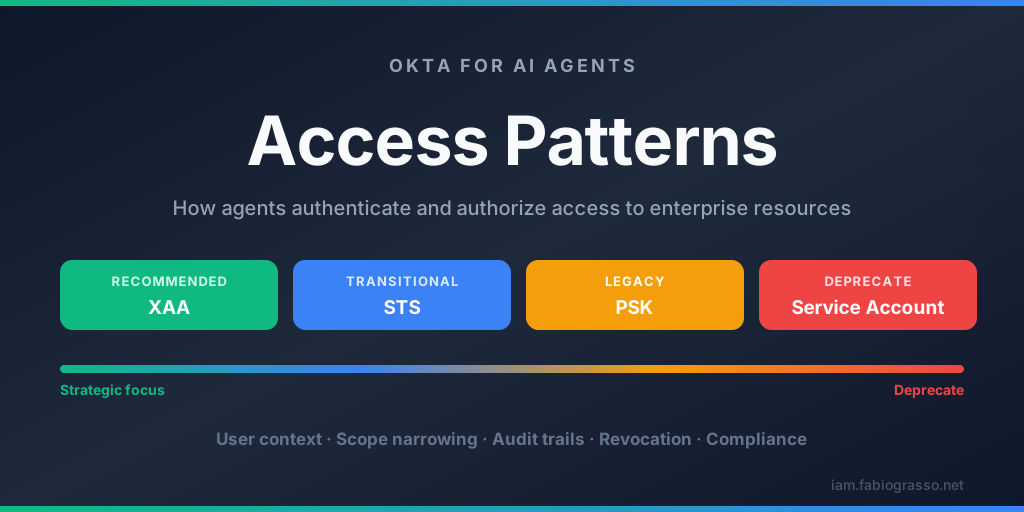
Okta for AI Agents (O4AA) provides four distinct access patterns, each optimized for different security models, resource capabilities, and compliance requirements1. The choice isn’t arbitrary: it’s a fundamental architectural decision that shapes your agent security posture.
Let’s examine each pattern, understand when to use it, and see how they fit into a coherent access strategy.
Access Patterns at a Glance #
The Okta for AI Agents (O4AA) platform offers four ways for an agent to reach a downstream resource. Each one is configured as a Managed Connection attached to the agent’s workload principal in Okta. Picking the right pattern comes down to three factors:
- What does the downstream resource support? (XAA, ID-JAG, OAuth, API key, username/password)
- Is user-level context required? (Audit attribution, per-user scope narrowing)
- What are your security and governance requirements? (Compliance profile, revocation granularity)
The Four Patterns #
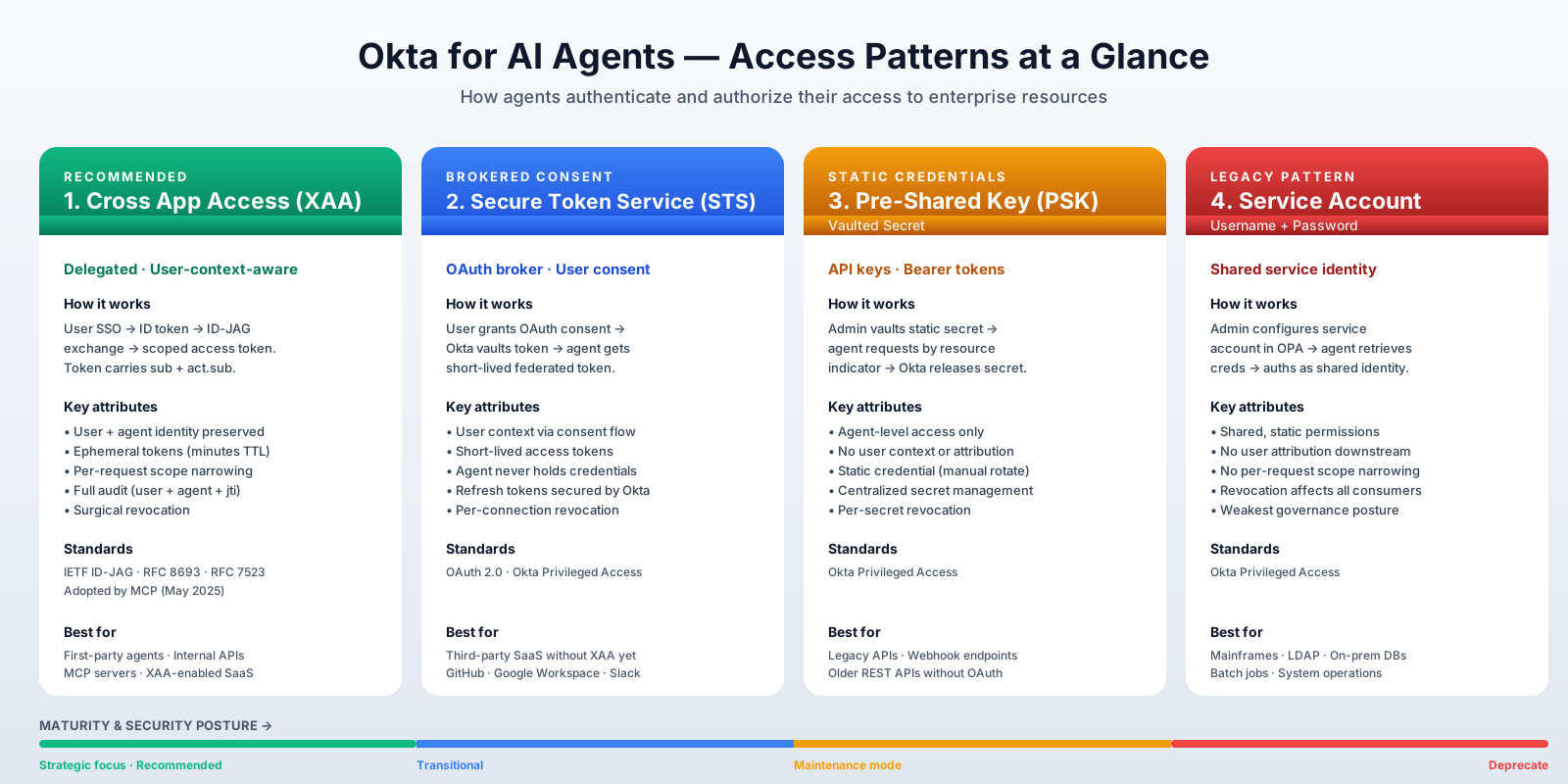
| Pattern | Recommendation | User Context | Best For |
|---|---|---|---|
| Cross App Access (XAA) | ✅ Recommended | ✅ Yes | Internal APIs, MCP servers, ISV-enabled SaaS |
| Secure Token Service (STS) | 🔄 Transitional | ✅ Yes | Third-party SaaS with OAuth (GitHub, Google, Slack) |
| Pre-Shared Key (PSK) | ⚠️ Legacy | ❌ No | API-key-only services, legacy REST APIs |
| Service Account | 🚫 Deprecate | ❌ No | Username/password-only systems (last resort) |
XAA is where we have the strongest maturity and focus. Every upcoming capability (Agent Gateway, MCP Server authentication, Agent-to-Agent delegation) builds on the same ID-JAG exchange that XAA introduced. The strongest signal? The MCP specification chose XAA as its enterprise authentication model in May 20252, making it a de facto industry standard.
Pattern Comparison Matrix #
| Dimension | XAA | STS | PSK | Service Account |
|---|---|---|---|---|
| User context in token | ✅ Full (sub + act.sub) |
✅ Via consent flow | ❌ None | ❌ None |
| Scope narrowing | ✅ Dynamic, per-request | ⚠️ Fixed at connection time | ❌ None | ❌ None |
| Token lifetime | ✅ Minutes (ephemeral) | ✅ Short-lived access tokens | ❌ Static secret | ❌ Static password |
| Audit depth | ✅ Full (User + agent + transaction ID) | ✅ Partial (User + agent) | ⚠️ Agent identity only | ❌ Shared service identity |
| Revocation precision | ✅ Per-user, per-agent, per-session | ⚠️ Per-connection | ⚠️ Per-secret | ❌ All-or-nothing |
| ISV adoption needed | ⚠️ Yes (ID-JAG validation) | ✅ No (standard OAuth) | ✅ No (API key) | ✅ No (user/pass) |
| Okta roadmap focus | ✅ Strategic focus | 🔄 Transitional (Bridge to XAA) | ⚠️ Legacy support | 🚫 Deprecate |
Decision Framework #
The framework prioritizes patterns by security posture: XAA provides the strongest guarantees, while Service Account represents the weakest (and should be treated as temporary).
---
config:
  layout: dagre
---
flowchart TB
    A["Does resource support ID-JAG?"] -- Yes --> XAA["✅ Use XAA
User-delegated, full audit,
surgical revocation"]
    A -- No --> B["Does resource support OAuth 2.0?"]
    B -- Yes --> C["Is user context essential?"]
    B -- No --> SA2["🚫 Service Account
Only option - plan migration immediately"]
    C -- Yes --> STS["🔄 Use STS
User-consented token brokering"]
    C -- No --> D["Does resource support API keys?"]
    D -- Yes --> PSK["⚠️ Use PSK
Vaulted secret"]
    D -- No --> SA1["🚫 Service Account
Last resort - plan migration"]

    A@{ shape: hex}
    B@{ shape: hex}
    C@{ shape: hex}
    D@{ shape: hex}
    style XAA fill:#d4edda,stroke:#28a745
    style SA2 fill:#f8d7da,stroke:#dc3545
    style STS fill:#cce5ff,stroke:#0d6efd
    style PSK fill:#fff3cd,stroke:#ffc107
    style SA1 fill:#f8d7da,stroke:#dc3545
Cross App Access (XAA) #
Cross App Access (XAA) is the flagship access pattern for Okta for AI Agents. It implements user-delegated, user-context-aware access through the Identity Assertion JWT Authorization Grant (ID-JAG), an emerging IETF standard for secure delegation3.
For detailed configuration steps, see the Cross App Access documentation.
Why XAA Matters #
XAA is the first access pattern to embed full identity context at every hop in an agent workflow. Every token carries both:
sub: The user identity (who authorized this action)act.sub: The agent identity (which agent is acting on their behalf)
This dual-identity structure enables capabilities impossible with traditional service accounts:
- Per-user audit attribution: Every agent action is traceable to the specific user who authorized it
- Surgical revocation: Disable one user’s access to one agent without affecting other users or agents
- Scope narrowing: The token’s effective permissions are the narrowest overlap of what the agent is allowed, what the user is entitled to, and what the specific task requires
- Regulatory compliance: Complete audit trails satisfying NIST SP 800-63-4, EU AI Act, and NIS2 traceability requirements
How XAA Works: The ID-JAG Flow #
The XAA flow involves a token exchange sequence where Okta vouches for the user’s identity to the target resource’s authorization server.
sequenceDiagram
    autonumber
    actor User
    participant Agent as AI Agent
    participant OktaAS as Okta Org AS
    participant CustomAS as Custom AS
    participant Resource as Protected Resource

    User->>Agent: Initiates action
    Agent->>OktaAS: Request ID Token (OIDC)
    OktaAS-->>Agent: ID Token (sub: user@acme.com)
    Agent->>OktaAS: Token Exchange Request (ID-JAG)
    OktaAS-->>Agent: ID-JAG Assertion
    Agent->>CustomAS: Present ID-JAG + requested scopes
    CustomAS->>CustomAS: Validate ID-JAG signature (JWKS)
    CustomAS->>CustomAS: Evaluate RBAC policy
    CustomAS-->>Agent: Scoped Access Token (sub + act.sub)
    Agent->>Resource: API call with Access Token
    Resource->>Resource: Validate token claims
    Resource-->>Agent: Response data
Step-by-step breakdown:
- User initiates action: User interacts with the AI agent (e.g., “Show me my open opportunities”)
- Agent obtains ID Token: Agent authenticates to Okta Org Authorization Server via OIDC
- Token exchange (ID-JAG): Agent exchanges the ID Token for an Identity Assertion JWT
- Present to resource AS: Agent presents the ID-JAG to the target resource’s Custom Authorization Server
- Policy evaluation: Custom AS validates the ID-JAG signature via Okta’s JWKS endpoint and enforces RBAC policies, checking the user’s group memberships and configured scope entitlements
- Scoped token issued: Custom AS issues an access token containing both
sub(user) andact.sub(agent) with narrowed scopes - Resource access: Agent calls the protected resource with the scoped token (expires in minutes)
The ID-JAG Standard #
ID-JAG (Identity Assertion JWT Authorization Grant) is based on several IETF standards:
- RFC 8693: OAuth 2.0 Token Exchange
- RFC 7523: JWT Profile for OAuth 2.0 Client Authentication
- IETF draft-02: Identity JWT Authorization Grant specification
For a comprehensive overview of Cross App Access and how it fits into the OAuth ecosystem, see the OAuth.net Cross App Access reference.
The key innovation is the act claim, which captures the actor (agent) identity separately from the subject (user) identity. This enables a clean separation of “who is this action for” versus “what system is performing the action.”
Token Structure #
A typical XAA access token contains:
{
  "sub": "john@example.com",
  "act": {
    "sub": "sales-representative",
    "aud": "okta.com"
  },
  "aud": "crm-orders-api",
  "scope": "orders:read accounts:read",
  "jti": "s2r3d4x3m6a0q1l",
  "iat": 1735571312,
  "nbf": 1735571312,
  "exp": 1735571468
}| Claim | Purpose | Audit/Compliance Value |
|---|---|---|
sub |
User identity | Answers: “Which user authorized this action?” |
act.sub |
Agent identity | Answers: “Which agent performed this action?” |
aud |
Target resource | Answers: “What system was accessed?” |
scope |
Granted permissions | Answers: “What operations were permitted?” |
jti |
Transaction ID | Unique identifier for correlation across systems |
exp |
Expiration (minutes) | Ensures ephemeral access; limits blast radius |
An agent running for a sales manager might have access to orders:read, orders:write, and accounts:read. But when processing a specific task (“list my open deals”), the request can be narrowed to just orders:read. The effective permission is always the intersection of what the agent can do, what the user can do, and what this specific request needs.
XAA Use Cases #
Use Case 1: Internal API via MCP Server
A customer support agent needs to access the internal order database to answer customer queries.
- Agent registered in Okta Universal Directory
- MCP Server protected by Okta Custom Authorization Server
- XAA flow: Agent exchanges user’s ID Token for scoped access to
orders:read - Audit: Every query logged with user ID, agent ID, and transaction ID
Use Case 2: First-Party SaaS (ISV-Enabled)
A sales assistant agent accessing Salesforce opportunities on behalf of a sales rep.
- Salesforce implements ID-JAG validation
- Agent presents ID-JAG to Salesforce authorization endpoint
- Salesforce issues scoped token for the user’s data only
- No static credentials; no shared service accounts
Use Case 3: Multi-Step Agent Workflows
A finance agent executes an approval workflow:
- Step 1: Read expense report (
read:expensesscope) - Step 2: Check budget availability (
read:budgetsscope) - Step 3: Submit approval (
write:approvalsscope)
Each step can request different scopes. If the agent is compromised mid-workflow, revocation stops only that user’s session without affecting others.
XAA is fully functional today for Okta Custom Authorization Servers (connection type: “Authorization Server”) and MCP Servers (connection type: “MCP Server”). ISV adoption for third-party SaaS integrations is currently in progress. Major vendors are actively working on ID-JAG support. Start building on XAA now so you’re ready to extend to SaaS integrations as soon as ISVs complete their implementations. Until then, use STS (connection type: “Application”) for third-party SaaS that supports OAuth but not yet ID-JAG.
Configuration Overview #
Implementing XAA requires:
- Register the agent in Okta Universal Directory as a workload principal
- Create a Managed Connection and select “Authorization Server” (for custom APIs) or “MCP Server” (for MCP endpoints). Both use the same ID-JAG exchange under the hood.
- Configure the Custom Authorization Server protecting your resource
- Define RBAC policies that evaluate both user and agent attributes
Example policy logic:
IF (act.sub == "sales-representative")
AND (sub IN groups["sales-team"])
AND (requested_scope IN ["sales:read", "accounts:read"])
THEN issue_token_with_scope
ELSE deny
The policy ensures the agent can only access sales data when the user is a member of the sales team.
Custom Authorization Server policies require expertise. Begin with simple rules (allow all agent-requested scopes when user has permission) and refine incrementally based on audit data.
Testing XAA: The xaa.dev Playground #
Okta provides an interactive testing environment at xaa.dev where you can experiment with XAA flows without infrastructure setup4.
Features:
- Browser-based testing (no Docker or local configuration)
- Pre-configured components: Requesting App, Resource App, IdP
- Get started in under 60 seconds
- Register your own custom clients for testing
The playground includes a sample flow where “Bob Tables” creates and manages tasks through an AI agent, demonstrating the full ID-JAG exchange.
XAA Limitations #
-
ISV adoption in progress: XAA is GA on the Okta side, but third-party SaaS integrations require ISV support. Major vendors are actively implementing ID-JAG, building on XAA today ensures you’re ready when they ship.
-
Token lifetime vs. long-running sessions: Tokens expire in minutes, requiring new exchanges for each request. This is by design (limits blast radius) but may impact agents that cache credentials.
-
Not suitable for: Agents that must operate offline or cache credentials indefinitely. For these scenarios, consider STS with careful credential lifecycle management.
Secure Token Service (STS) #
Secure Token Service (STS) enables agents to access third-party SaaS applications that support OAuth but haven’t yet adopted XAA. Okta acts as a secure broker, vaulting user-consented tokens and providing short-lived federated access at runtime.
In the Okta admin console, you configure STS by creating a managed connection with the “Application” resource type, selecting an OIN app integration or a custom resource server. Okta then brokers the OAuth token exchange between the agent and the third-party service.
When to Use STS #
- Third-party SaaS with OAuth support (GitHub, Google Workspace, Slack, Jira)
- User-level context is required for audit and compliance
- ISV hasn’t implemented ID-JAG validation yet
How STS Works #
sequenceDiagram
    autonumber
    actor User
    participant Okta as Okta (Token Broker)
    participant ThirdParty as Third-Party SaaS
    participant Agent as AI Agent

    rect rgb(240, 248, 255)
        Note over User,ThirdParty: One-Time Consent Flow
        User->>Okta: Authenticate
        Okta->>ThirdParty: OAuth Authorization Request
        ThirdParty-->>User: Consent Screen
        User-->>ThirdParty: Approve access
        ThirdParty-->>Okta: Authorization Code
        Okta->>ThirdParty: Exchange for tokens
        ThirdParty-->>Okta: Access + Refresh Tokens
        Okta->>Okta: Vault tokens (Privileged Access)
    end

    rect rgb(255, 248, 240)
        Note over Agent,ThirdParty: Runtime Agent Access
        Agent->>Okta: Request access (workload identity)
        Okta->>Okta: Validate managed connection policy
        Okta-->>Agent: Short-lived federated token
        Agent->>ThirdParty: API call with token
        ThirdParty-->>Agent: Response
    end
STS Token Flow #
- One-time consent: User authenticates and consents to the third-party service
- Token vaulting: Okta secures the access and refresh tokens in Okta Privileged Access
- Runtime access: Agent authenticates to Okta with its workload principal
- Token exchange: Okta issues a short-lived federated token for the downstream service
- API access: Agent calls the third-party API with the short-lived token, crucially, user credentials never touch the agent
Key difference from XAA #
- Consent flow: STS requires the user to go through the third-party’s OAuth consent screen; Okta then stores and manages those tokens on behalf of the agent. XAA skips the consent screen entirely. Delegation happens at agent registration time in Okta.
- Audit trail: STS captures user consent and agent access in Okta logs, but the third-party service may only see the agent identity. XAA provides full user+agent context to the resource.
- Token lifetime: The federated token issued to the agent is short-lived (minutes) to limit risk, but the underlying access/refresh tokens in Okta may have longer lifetimes depending on the third-party service’s policies.
- Revocation: Revoking access requires deleting the vault entry in Okta, which may affect all agents using that connection. No per-user revocation within the third-party service.
- Scope narrowing: The agent receives whatever scopes the user consented to during the OAuth flow. Okta can’t dynamically narrow scopes per request like XAA.
STS Use Cases Examples #
- GitHub: Agent reads repositories and creates pull requests on behalf of developers
- Google Workspace: Agent manages calendar events and sends emails for users
- Slack: Agent posts notifications and manages channels
- Jira/Confluence: Agent creates tickets and updates documentation
Unlike Pre-Shared Key, STS preserves user context through the consent flow. Audit logs capture both the user who consented and the agent that accessed the resource.
Strategic Direction #
STS is explicitly a transitional bridge pattern. Once a ISV or SaaS vendor ships ID-JAG support, you can upgrade that connection from STS to XAA without re-architecting. Until then, STS gives you user-level context that Pre-Shared Key and Service Account simply can’t provide.
Pre-Shared Key (PSK) or Vaulted Secret #
Pre-Shared Key (PSK) stores static credentials (API keys, bearer tokens, webhook secrets) in Okta Privileged Access (OPA). The agent retrieves secrets at runtime rather than embedding them in code or configuration.
When to Use Pre-Shared Key #
- Legacy REST APIs that only support API key authentication
- Webhook endpoints requiring bearer tokens
- Third-party integrations with static token auth
- Early-phase services that will eventually add OAuth
How Pre-Shared Key Works #
sequenceDiagram
    autonumber
    participant Admin as Admin
    participant Okta as Okta (Privileged Access)
    participant Agent as AI Agent
    participant Resource as Protected Resource

    rect rgb(240, 255, 240)
        Note over Admin,Okta: Configuration Phase
        Admin->>Okta: Create & vault secret (API key)
        Admin->>Okta: Create managed connection on agent
    end

    rect rgb(255, 248, 240)
        Note over Agent,Resource: Runtime Access
        Agent->>Okta: Authenticate (workload principal)
        Okta->>Okta: Validate managed connection policy
        Okta-->>Agent: Release secret
        Agent->>Resource: API call with secret
        Resource-->>Agent: Response
    end
Pre-Shared Key Limitations #
| Limitation | Impact |
|---|---|
| No user context | Resource sees agent identity only, not the user |
| No scope narrowing | Agent has full access granted to the credential |
| Limited audit trail | Logs show agent access, not user attribution |
Pre-Shared Key has limited audit trail and no user context. Plan migration to XAA or STS as downstream services add OAuth support. This pattern should be treated as temporary for legacy integrations.
Configuration #
- Create the secret in Okta Privileged Access
- Create a managed connection on the agent (type: Secret)
- Specify a Resource Indicator (identifier the agent uses to request the secret)
- Agent authenticates and requests the secret by resource indicator
When possible (i.e. for supported SaaS Services) configure the vault to automatically rotate credentials. This reduces risk if a credential is compromised, but requires the downstream service to support credential updates without downtime.
Service Account #
Service Account uses username and password credentials linked to a shared service identity. This is the legacy pattern that Okta explicitly recommends migrating away from.
How Service Account Works #
sequenceDiagram
    autonumber
    participant Admin as Admin
    participant Okta as Okta (Privileged Access)
    participant AgentA as Agent A
    participant AgentB as Agent B
    participant Resource as Protected Resource

    Admin->>Okta: Create service account (svc_agent@acme)
    Admin->>AgentA: Register with managed connection
    Admin->>AgentB: Register with managed connection

    AgentA->>Okta: Request credentials
    AgentB->>Okta: Request credentials
    Okta-->>AgentA: Username/Password
    Okta-->>AgentB: Username/Password

    AgentA->>Resource: Authenticate as svc_agent@acme
    AgentB->>Resource: Authenticate as svc_agent@acme

    Note over Resource: Both appear as same identity!
The Problem with Service Accounts #
Service Accounts presents four critical security gaps:
- Invisible agents: Multiple agents share a single identity, making it impossible to tell which one performed an action
- Excessive permissions: Service accounts typically carry broad, static privileges that far exceed what any single task requires
- Missing user attribution: Compliance audits can’t answer “which user triggered this data access?”
- All-or-nothing revocation: Deactivating the service account kills access for every agent and system that depends on it
Service Accounts are “not as secure as the authorization server or vaulted secret resource types.” New integrations should never default to this pattern.
When Service Account is Unavoidable #
- Legacy systems requiring username/password authentication (on-prem databases, mainframes, LDAP-backed services)
- Batch processing with no end-user context
- Systems that have not adopted any modern authentication method
Migration Path #
- Audit: Identify all service accounts currently in use
- Evaluate: Can the resource support OAuth? → Migrate to XAA/STS
- Fallback: Can we use API keys? → Migrate to Pre-Shared Key
- Interim: Service Account acceptable only for batch processes with no user context, with a documented sunset plan
Service Account vs Pre-Shared Key #
Both patterns lack user context and lack scope narrowing, but they differ in the type of credential stored and the security posture:
| Dimension | Pre-Shared Key (PSK) | Service Account |
|---|---|---|
| Credential type | API key / bearer token / webhook secret | Username + password |
| Connection type in Okta | Secret |
Service Account |
| Target systems | Modern REST APIs with API-key auth, webhooks | Legacy systems: on-prem DBs, mainframes, LDAP |
| Identity model | Credential scoped to one integration | Shared identity reused across many agents |
| Revocation | Per-secret (rotate the key) | All-or-nothing (deactivating kills every dependent agent) |
| Audit trail | Agent identity visible | Only the shared service identity, you can’t tell which agent acted |
| Rotation | Vault can auto-rotate when SaaS supports it | Password rotation is typically manual and risky |
| Okta recommendation | ⚠️ Acceptable (legacy) | 🚫 Deprecate, explicit deprecation target |
PSK vaults a machine-native credential (API key) that is typically unique per integration, so rotation and revocation stay surgical. Service Account borrows a human-shaped credential (username/password) to impersonate a shared identity: multiple agents share the same login, which is exactly what breaks per-agent attribution and forces all-or-nothing revocation. That is why moving from Service Account to PSK is the first defensible step on the migration ladder, even though neither pattern carries user context.
Strategic Recommendations #
Pattern Selection by Compliance Profile #
| Requirement | XAA | STS | Pre-Shared Key | Service Account |
|---|---|---|---|---|
| NIST SP 800-63-4 alignment | ✅ Full | ✅ High | ⚠️ Moderate | ❌ Low |
| EU AI Act traceability | ✅ Full | ✅ High | ⚠️ Limited | ❌ Insufficient |
| NIS2 accountability | ✅ Full | ✅ High | ⚠️ Limited | ❌ Insufficient |
| DORA requirements | ✅ Full | ✅ High | ⚠️ Limited | ❌ Insufficient |
| Per-user attribution | ✅ Yes | ✅ Yes | ❌ No | ❌ No |
| Audit trail depth | ✅ Rich | ✅ Good | ⚠️ Limited | ❌ Poor |
| Recommended for regulated industries | ✅ Yes | ✅ Yes | ⚠️ With controls | ❌ No |
NIST SP 800-63-4 emphasizes continuous monitoring and user attribution. XAA aligns directly with these requirements. Service Account patterns may require compensating controls to meet compliance thresholds.
Implementation Sequencing #
Phase 1: Audit existing integrations
- Map all agent connections to one of the four patterns
- Identify service accounts and pre-shared keys
Phase 2: New integrations default to XAA
- Use STS or Pre-Shared Key only when XAA isn’t supported
- Document rationale for non-XAA choices
Phase 3: Monitor ISV roadmaps
- As ISVs adopt ID-JAG, migrate STS connections to XAA
- Track adoption announcements (Salesforce, GitHub, etc.)
Phase 4: Service Account sunset
- Establish formal deprecation timeline
- Migrate to Pre-Shared Key or STS as intermediate step
- Target zero service accounts for user-context workloads
Okta for AI Agents (O4AA) can help you during this transition, providing a unified platform to manage all four patterns while you modernize your architecture. Start with XAA for new integrations and use O4AA’s flexible managed connections to bridge legacy systems as you migrate.
From Theory to Practice: Configuring Access Patterns in Okta #
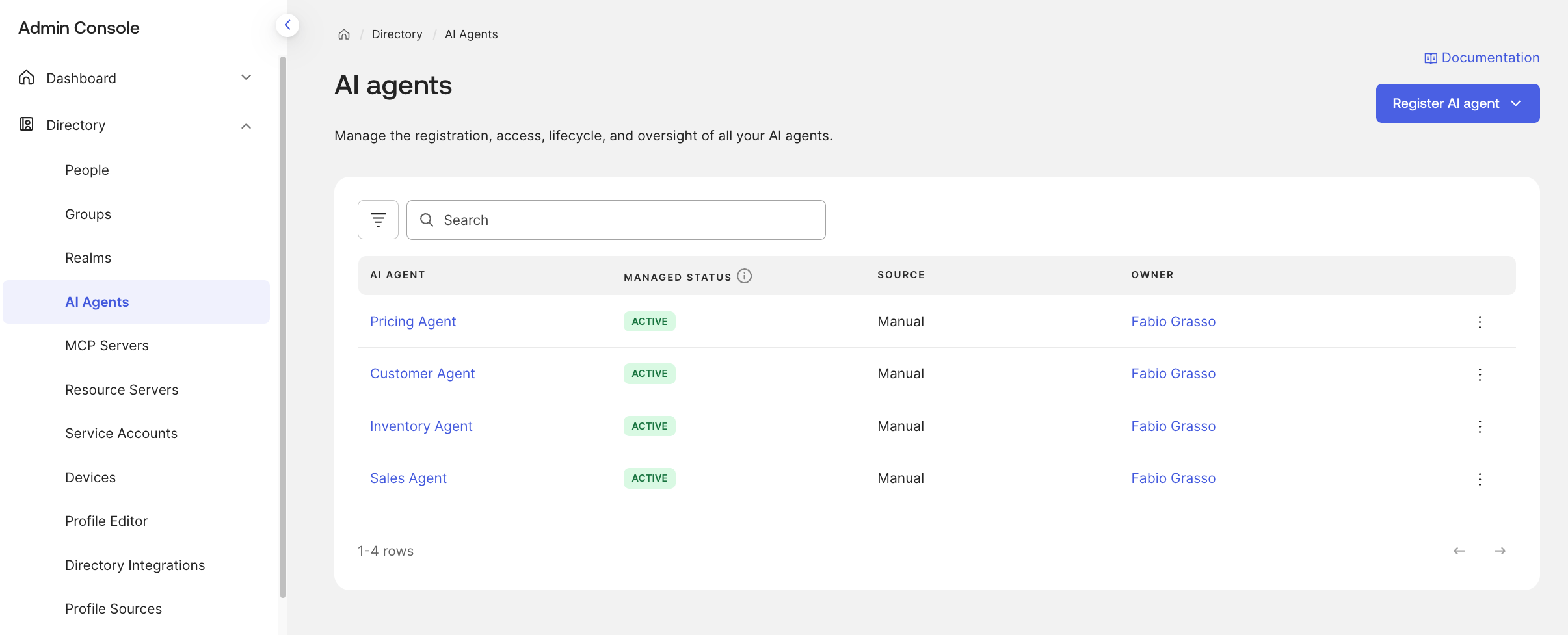
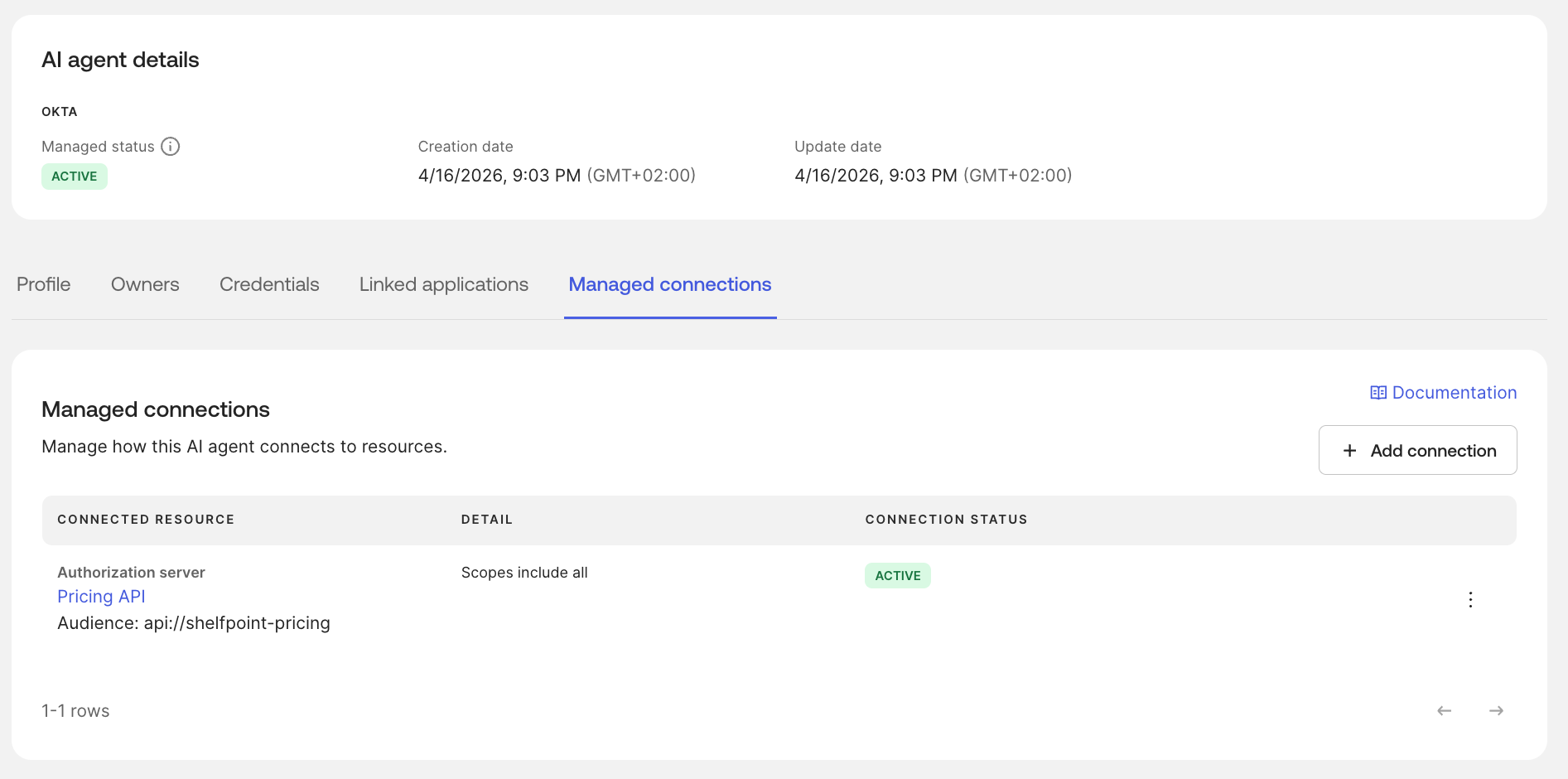
In Okta’s Universal Directory, you can register AI agents as workload identities and create Managed Connections that define how they access downstream resources. Each connection type corresponds to one of the access patterns we’ve discussed.
| AI Agents List | AI Agent Detail |
|---|---|
|
|
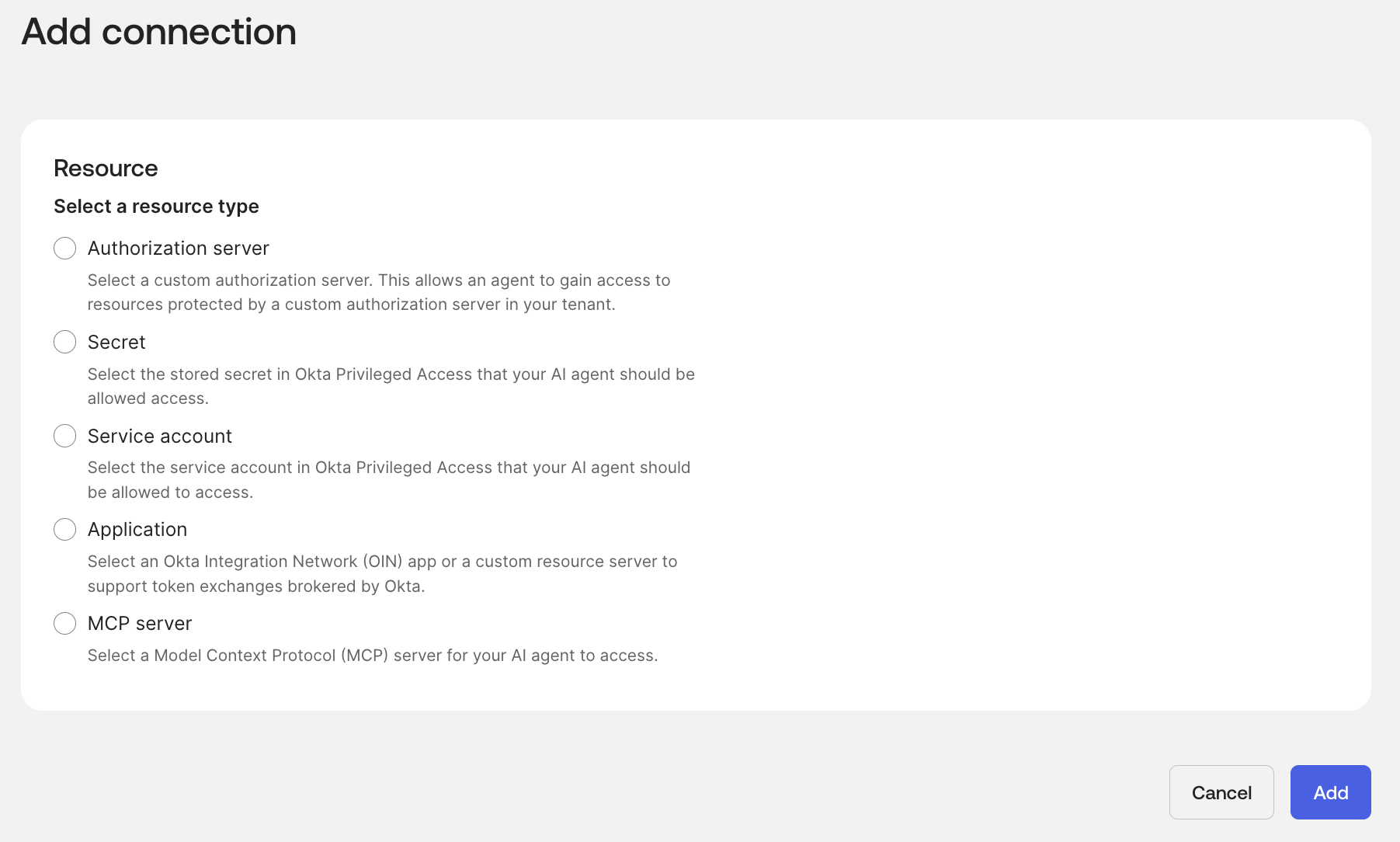
When you create a managed connection, you’ll see five resource types. They map to the four access patterns covered in this article:
| Connection Type | Access Pattern | What It Does |
|---|---|---|
| Authorization Server | XAA (Cross App Access) | Agent gets scoped tokens from an Okta Custom Authorization Server via ID-JAG exchange |
| Secret | Pre-Shared Key (PSK) | Agent retrieves a vaulted API key or bearer token from Okta Privileged Access |
| Service Account | Service Account | Agent retrieves username/password credentials for a service identity vaulted in Okta Privileged Access |
| Application | STS (Secure Token Service) | Agent accesses an OIN app or custom resource server through Okta-brokered OAuth token exchange |
| MCP Server | XAA (Cross App Access) | Same ID-JAG exchange as Authorization Server, specialized for the MCP protocol surface |
The MCP Server connection type is not a separate access pattern: it’s XAA applied specifically to Model Context Protocol servers. The same ID-JAG delegation model, token structure (sub + act.sub), and policy enforcement apply. Okta provides a dedicated connection type to streamline MCP-specific configuration.
Conclusions #
The choice of access pattern isn’t a technical detail: it’s an architectural decision that shapes your AI agent security posture for years to come.
Key takeaways:
-
XAA is the future: User-delegated, auditable, compliant. Investing in XAA now means your architecture is ready for MCP Server and Agent-to-Agent support the moment they land.
-
STS bridges the gap: For third-party SaaS that supports OAuth but not ID-JAG, STS provides user context while you wait for ISV adoption.
-
Pre-Shared Key is acceptable for legacy: API-key-only services need vaulted secrets, but plan migration as resources modernize.
-
Service Account is technical debt: Every service account is a compliance gap waiting to surface in an audit. Start planning your exit.
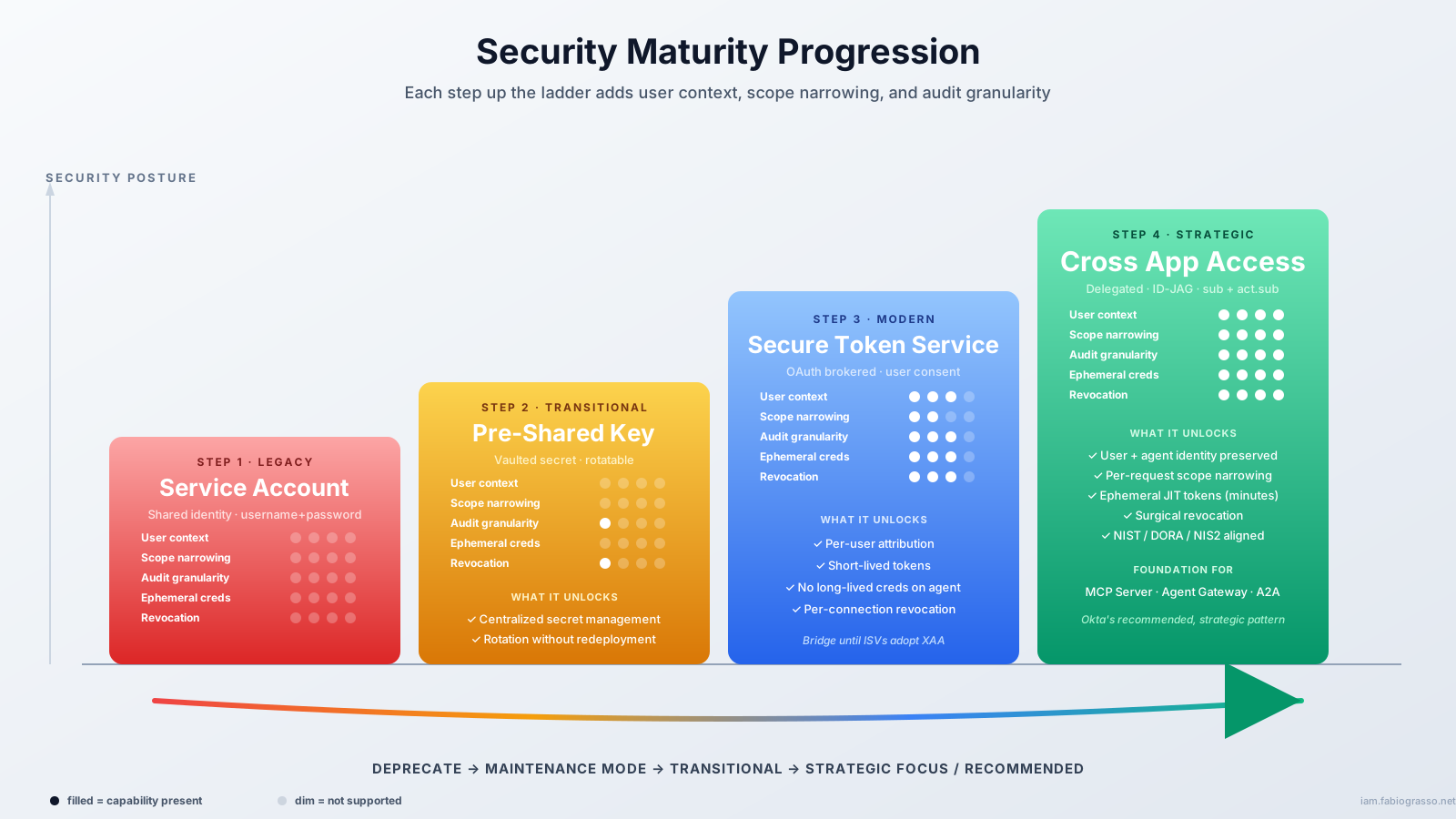
The journey from Service Account → Pre-Shared Key → STS → XAA represents a security maturity progression. Each step up the ladder adds user context, scope narrowing, and audit granularity.
Getting Started #
Test XAA Today #
Explore the interactive XAA playground at xaa.dev, no setup required. Experience the full ID-JAG flow in your browser.
Learn More #
- Okta for AI Agents: Platform overview
- Cross App Access Solution: XAA solution page
- Cross App Access Documentation: Official configuration guide
- XAA.dev Documentation: Interactive playground docs
- Cross App Access Introduction: Technical deep dive
- XAA Developer Playground: Hands-on tutorial
- Building Resource Apps: Implementation guide
- Agentic Enterprise Blueprint: Strategic governance framework
Join the Conversation #
Which integrations in your environment are still using service accounts? Have you started mapping your agent connections to these access patterns? Where are you in that journey?
Share your experience in the comments below or connect with me on LinkedIn to continue the discussion.
-
Okta for AI Agents: Product Overview, Okta, 2026 ↩︎
-
MCP Specification: Enterprise Authentication, Model Context Protocol, May 2025 ↩︎
-
Identity JWT Authorization Grant, IETF OAuth Working Group, 2025 ↩︎
-
XAA Developer Playground, Okta Developer Blog, January 2026 ↩︎